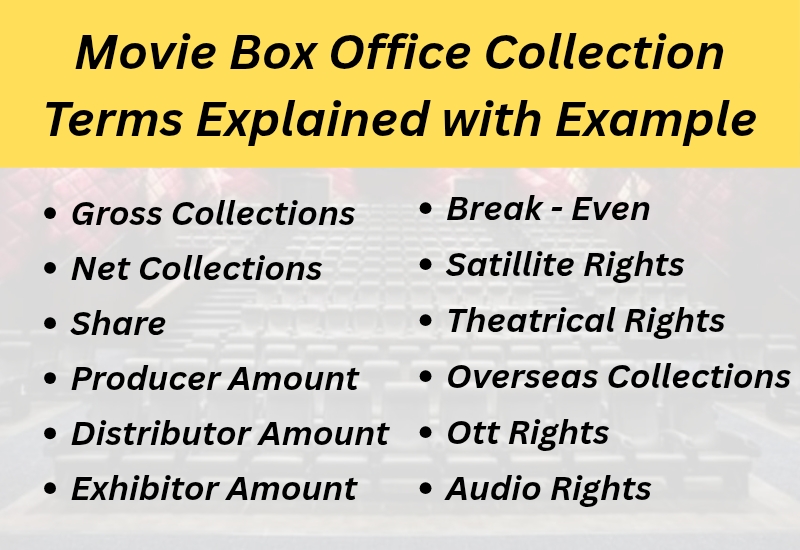
In the film industry, box office collections are divided into several terms like Gross, Net, Share, Producer Amount, Distributor Amount, Exhibitor Amount, Break-even, Satellite Rights, Audio Rights, Theatre Rights, and Overseas Rights. Many movie lovers see these numbers daily, but only a few understand what they truly mean. Let us break them down with a clear example.
1. Gross Collection
Gross collection is the total money collected from theatres including ticket price + GST (taxes).
Example: If a movie sells tickets worth ₹100 crores including 18% GST, then Gross = ₹100 crores.
2. Net Collection
Net collection is the amount after deducting GST and other taxes from gross.
Example: From ₹100 crores gross, if 18% GST is deducted, Net = ₹82 crores.
3. Share (Distributor Share)
Share is the amount that goes to the distributor after exhibitor (theatre owner) takes their percentage. Usually, exhibitors take 40-50% in the first week.
Example: If Net is ₹82 crores, and theatre owners take 50%, distributor share = ₹41 crores.
4. Producer Amount
Producer gets money by selling distribution rights before or after release. He earns through:
Theatrical rights (distributors)
Satellite rights (TV channels)
OTT rights
Audio rights
If the producer sells theatrical rights for ₹60 crores and distributors earn ₹41 crores share, distributor faces a loss of ₹19 crores unless recovery comes from later weeks.
5. Distributor Amount
The amount distributor invests to buy theatrical rights from producer.
Example: Distributor bought rights for ₹60 crores. He recovers only ₹41 crores in 1st week.
6. Exhibitor Amount (Theatre Owner)
Exhibitor earns from his share of ticket sales (generally 50%).
Example: From ₹82 crores Net, exhibitor takes ₹41 crores.
7. Break-even Point
Break-even is the minimum amount required for distributor to recover his investment.
Example: Distributor bought rights for ₹60 crores → He needs at least ₹60 crores share to break-even. If he earns more, it’s profit; if less, it’s a loss.
8. Satellite Rights
Satellite rights are sold to TV channels for telecasting.
Example: Popular star movies sell for ₹30–50 crores.
9. Audio Rights
Music companies buy audio rights for songs.
Example: Audio rights sold for ₹5 crores.
10. Theatre Rights
This means selling rights for screening movies in a specific region (AP, Telangana, Karnataka, Tamil Nadu, North India, etc.).
11. Overseas Rights
Overseas rights are sold to distributors outside India (USA, Gulf, UK, Australia, etc.).
Example: Overseas rights sold for ₹15 crores.
Full Example of a Movie Business
Let’s assume a Telugu big star movie:
Gross: ₹100 crores
Net: ₹82 crores
Exhibitor Share: ₹41 crores
Distributor Share: ₹41 crores
Distributor Investment: ₹60 crores
Loss: ₹19 crores (unless more weeks perform well)
Other Rights:
Satellite Rights: ₹35 crores
Audio Rights: ₹5 crores
Overseas Rights: ₹15 crores
OTT Rights: ₹40 crores
Total Non-Theatrical = ₹95 crores → This is extra income for producer.