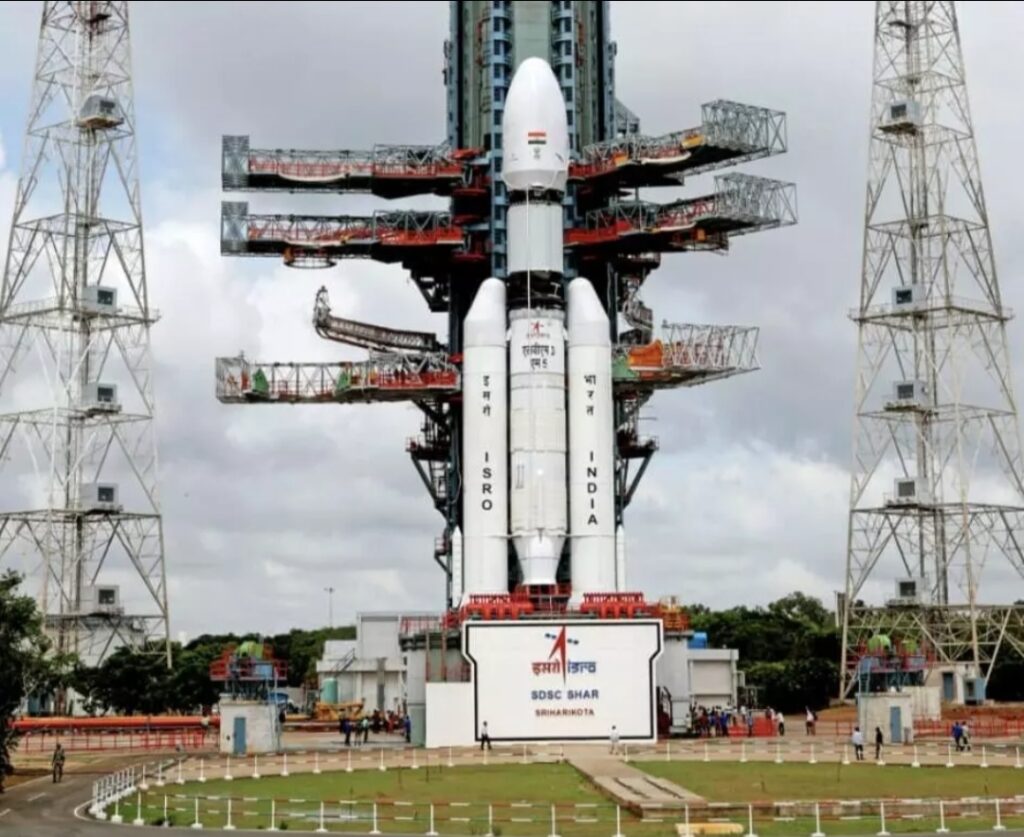
The Indian Space Research Organisation (ISRO) is preparing to launch India’s heaviest communication satellite, CMS-03, on November 2, 2025, from Sriharikota. This highly anticipated mission will use ISRO’s LVM3-M5 launch vehicle, marking its fifth operational flight. The mission aims to boost India’s communication infrastructure and expand its satellite-based services across land and sea.
The CMS-03 satellite, weighing approximately 4,400 kilograms, will be the heaviest communication satellite ever launched by ISRO into Geosynchronous Transfer Orbit (GTO). This advanced satellite is designed to provide multi-band communication services, ensuring seamless coverage over a wide oceanic and continental region.
The LVM3-M5 (Launch Vehicle Mark-3) is ISRO’s most powerful rocket to date, capable of launching heavy payloads into space. Known for its reliability, LVM3 has successfully carried out significant missions in the past, including Chandrayaan-3 and several commercial satellite launches. With CMS-03, the LVM3-M5 continues its record of excellence, demonstrating India’s growing strength in space technology and orbital deployment.
According to ISRO, the CMS-03 mission will provide multi-band communication services that will greatly enhance telecommunication, broadcasting, and data connectivity across remote regions. The satellite’s coverage area will include India and surrounding oceanic zones, making it a vital asset for maritime communication, disaster management, and digital infrastructure expansion.
One of the unique aspects of this mission is its payload capability. The CMS-03 satellite, being the heaviest ever built for communication purposes in India, showcases ISRO’s capability to develop large, complex systems domestically. This is a significant step toward India’s long-term goal of achieving complete self-reliance in space technology.
Officials at ISRO have expressed confidence in the LVM3-M5 launch, emphasizing its proven track record and precision performance. The success of CMS-03 will not only enhance India’s communication network but also pave the way for future missions involving even heavier payloads and interplanetary exploration.
With the CMS-03 launch, ISRO continues to expand its horizon in global space technology. The mission reinforces India’s reputation as a reliable space power capable of executing large-scale projects efficiently. It will also help strengthen India’s commercial launch capabilities by attracting international clients looking for dependable and cost-effective launch services.
ISRO’s upcoming projects, including Aditya-L1, NISAR (a NASA collaboration), and Gaganyaan, underline the organization’s steady advancement in research and innovation. Each mission adds a new milestone to India’s growing space legacy, making the country a formidable player in global space exploration.